Camera Grid

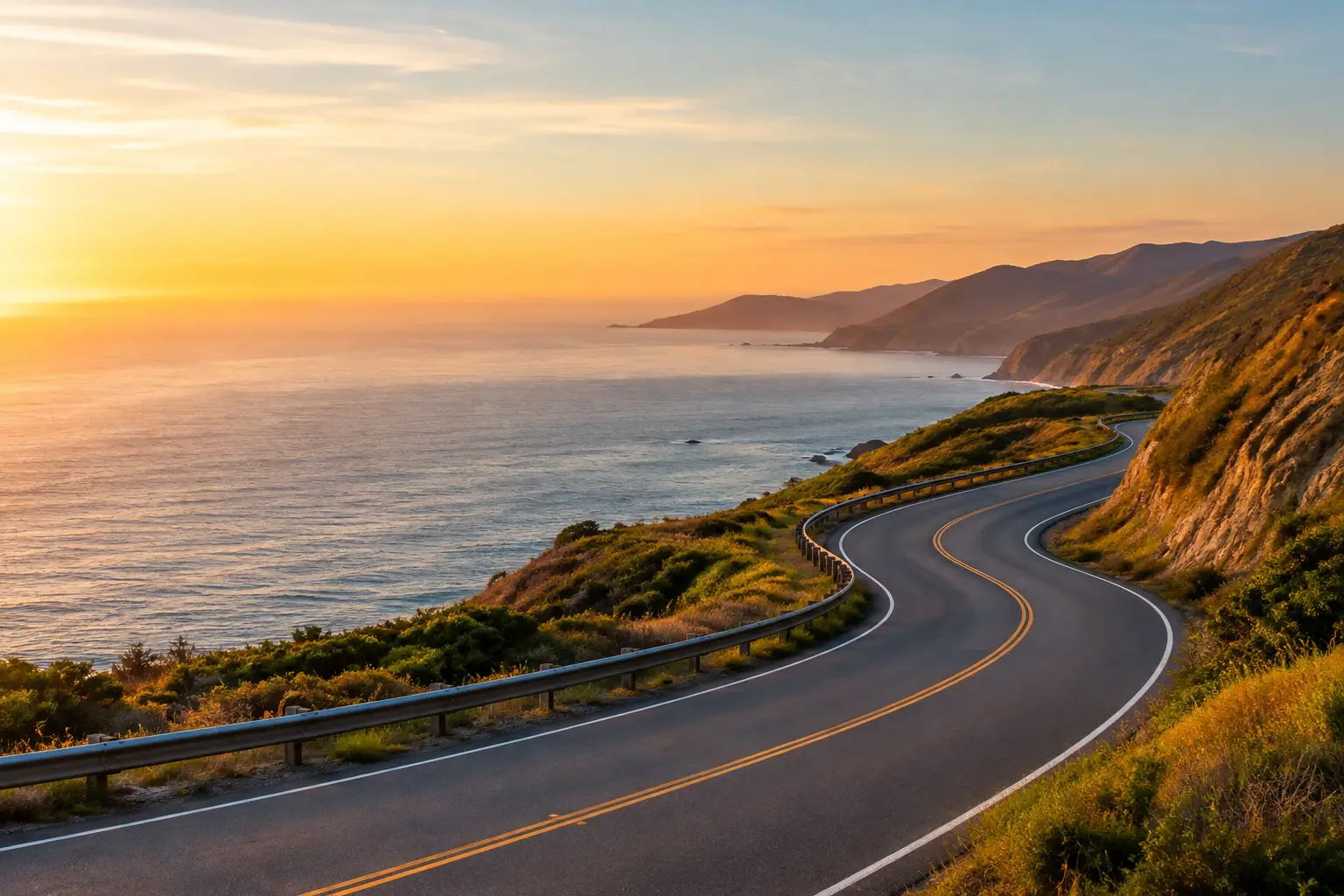
A winding road can look ordinary until it gives the eye somewhere to travel. That is the job of s curve photography composition: turn a scene into a visual route. The curve pulls attention from the foreground, through the frame, and toward a subject, horizon, or point of light.
Do not treat every bend as an S-curve. The shape needs to do useful work. It should connect meaningful parts of the photo, create depth, or slow the viewer down long enough to notice the scene. When it does, a simple iPhone photo feels deliberate rather than accidental.
What an S-Curve Does in a Photo
An S-curve is a sweeping line that changes direction twice, creating a loose S shape. It can be obvious, such as a coastal road seen from above. It can also be subtle: the edge of a river, a row of chairs, a person’s pose, a curl of steam over coffee, or the curve of a staircase.
Its strength comes from movement. Straight leading lines move the eye quickly and directly. An S-curve moves the eye in stages. It introduces the foreground, carries the viewer into the middle distance, then gives them a destination. That extra travel creates a stronger sense of depth in a flat screen image.
The curve does not need to look like a perfect letter S. In fact, a perfect shape can feel staged. Look for two connected turns that create a natural rhythm. One turn may be broad and the other tight. One may sit near the bottom edge while the other points toward the upper third. What matters is that the eye can follow it without getting lost.
Find the Curve Before You Raise the Camera
The fastest way to miss an S-curve is to focus only on the obvious subject. Instead, scan the edges and ground plane first. Look for a path, shoreline, table edge, railing, lane marking, shadow, or line of people that enters the frame near you and changes direction as it recedes.
Start low when the foreground matters. Holding your iPhone closer to the ground can make a small bend in a path or stream feel larger and more immediate. It also gives the first part of the curve enough visual weight to lead the photo.
Then ask one practical question: where does the curve end? A line that leads to an empty, distracting area is not helping. The best endpoint is usually a person, a building, a mountain, a bright reflection, or a clean patch of sky. If the curve has no destination, reframe until it does.
This is why a few steps matter more than a new editing preset. Pan left. Step back. Lower the phone. Move until the curve starts near an edge and finishes on something worth seeing.
Keep the entry point clear
A curve works best when the viewer can enter it easily. Place its beginning near a bottom corner or along the lower edge of the frame. Avoid cutting it off so tightly that the line appears to begin nowhere.
You do not need to include every inch of the path. You need enough foreground to establish direction. If the first bend is too close to the edge, take one step back or use a wider view. If the curve feels weak because it occupies too little of the frame, move closer rather than relying on a heavy crop later.
Give the curve a destination
The endpoint should earn the trip. In a landscape, it might be a lone tree on a ridge. In a street scene, it could be a cyclist rounding a corner. In food photography, a curved table setting may lead to the plate with the strongest color or texture.
Place that destination where it remains distinct from the background. A person in dark clothing against a dark wall may technically sit at the end of the curve, but the visual payoff is weak. Shift your angle until there is separation, contrast, or cleaner light behind the subject.
Use S Curve Photography Composition in Real Scenes
S-curves appear most often when you stop looking for them as named compositional devices. Look for arrangements that already guide attention.
Roads, trails, and shorelines
These are the classic examples because they naturally create depth. Do not shoot from the center of the road just because the road bends. Move to one side and let the near edge enter from a lower corner. This gives the frame a stronger starting point and keeps the route from splitting the image in half.
A wide lens can exaggerate the foreground bend, which is useful when the near section is textured or brightly lit. But wide views also stretch objects at the edges. Keep people away from the extreme sides of the frame if their proportions matter.
On a shoreline, wait for a wave line, wet sand, or reflected light to reinforce the curve. The waterline alone may be too faint. A small change in timing can make the route visible.
Architecture and interiors
Stairs, balconies, corridors, and curved facades can form precise S-shapes, but architecture punishes sloppy phone position. Keep the phone level first. Then decide whether the curve, not the building, is the primary subject.
If vertical lines are tilting, correct your position before you shoot. Tilt up only when the distortion supports the image. A dramatic upward angle can work for a spiral staircase. It usually weakens a hotel hallway or clean exterior where parallel lines should remain controlled.
Use repeating details as reinforcement. Handrails, lights, tiles, and windows can echo the curve and make the route easier to read. Remove competing lines when possible. One strong curve is enough.
Portraits and family photos
An S-curve can come from the pose rather than the environment. Ask a standing subject to shift weight to one leg, turn the shoulders slightly, and bend one arm with purpose. The body can create a relaxed line from head to hip to foot.
For a group, avoid arranging everyone in a flat row. Place one person slightly forward, another slightly back, and let faces or shoulders arc gently through the frame. Keep expressions and eye lines connected. A shape without human connection will look posed for the sake of posing.
With children, do not force the geometry. Photograph them walking along a curved path, leaning around a playground structure, or following a stream. The scene will often supply the line while their movement supplies the destination.
Food and tabletop scenes
At a table, curves are usually smaller and quieter. A linen napkin, spoon handle, pour of sauce, or sequence of dishes can move the eye through the image. Build the route from the lower edge toward the hero dish.
Watch for clutter. A strong curved napkin loses its effect if a receipt, glass rim, and spare fork interrupt it. Remove what does not support the visual path. Then lower the camera slightly instead of shooting straight down. A shallow angle often makes the curve more visible and gives the food dimension.
Control the Frame, Not Just the Line
An S-curve is not a replacement for subject placement, exposure, or clean edges. It is one organizing tool. Use it when the line supports the photo’s main idea.
Keep the subject large enough to matter. If the curve is beautiful but your person becomes a tiny dot, choose whether the image is about the landscape or the person. Both can work, but trying to make both dominant often produces a hesitant frame.
Also check the background beyond the curve’s endpoint. Bright signs, parked cars, or a cut-off figure can pull attention away from the intended finish. Shift a few inches. Wait a moment. Simplify the scene before pressing the shutter.
This is where live composition feedback is useful. Camera Grid can recognize a suitable scene and overlay its S-Curve guide directly in the viewfinder, so you can compare the route in front of you with the frame you are building. Follow one correction at a time. Reposition the entry point. Adjust the endpoint. Then shoot.
When Not to Use an S-Curve
Do not force the technique into a scene built around symmetry, strong diagonals, or a centered subject. A cathedral interior may need a centered composition. A fast sports image may need a direct diagonal that matches the action. A close portrait may need no visible line at all.
S-curves can also become decorative. If the line makes the photo busier, crop it out or choose a simpler angle. The goal is not to prove that you found an S. The goal is to make the viewer look where you intend.
The next time a path bends away from you, do not photograph it from wherever you happen to be standing. Find the entry. Find the turn. Find the destination. Frame it. Lock it.