Camera Grid

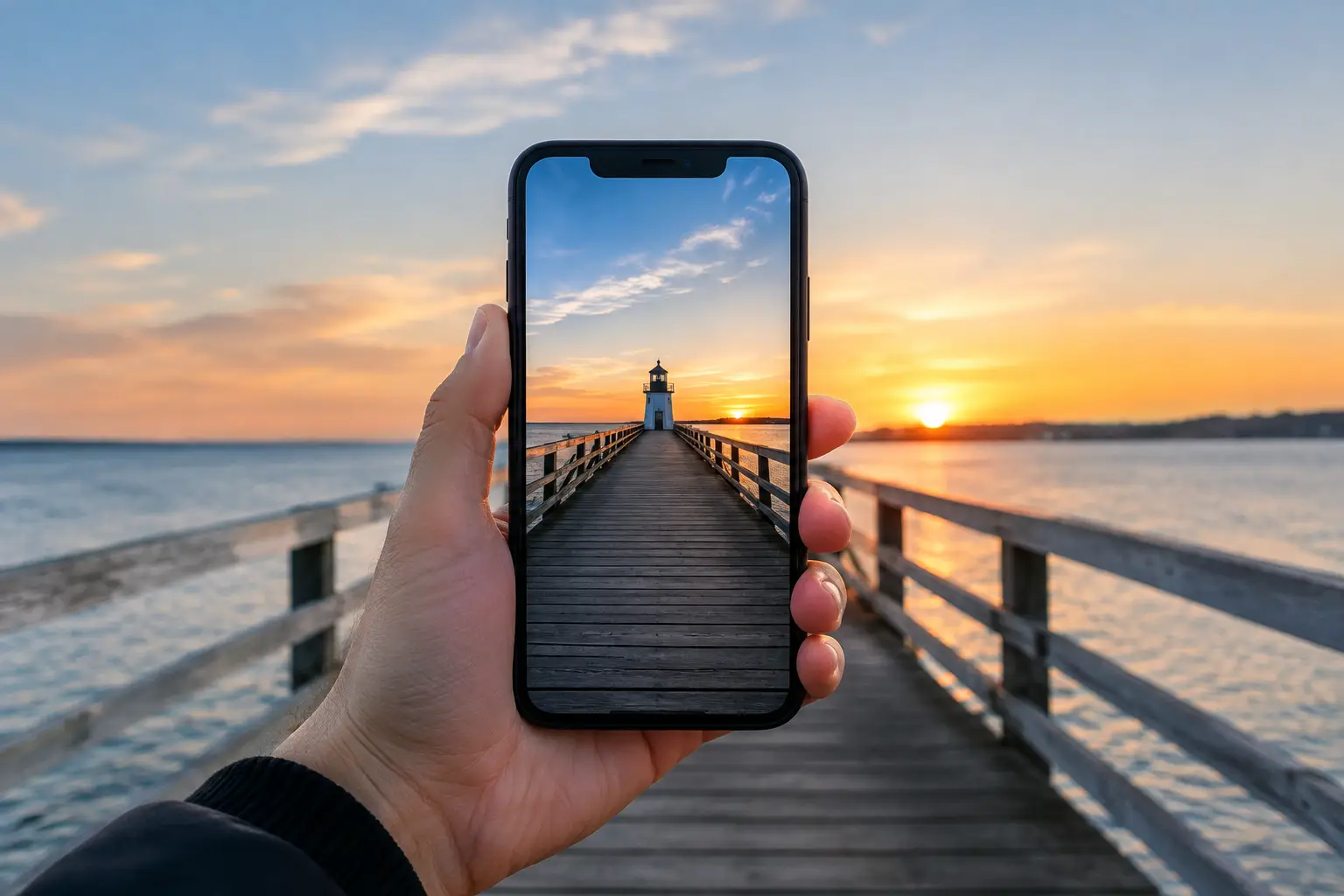
A path that begins at the bottom of your frame and disappears into fog already has a built-in instruction: look here, then keep looking. Leading lines iPhone photography is the practice of noticing that instruction and framing it deliberately. The line does not need to be dramatic. A curb, a countertop edge, a shadow, or a row of seats can give a photograph direction.
The mistake is treating every line as decoration. A line only earns its place when it leads the eye somewhere worth seeing. Find the subject first. Then use the scene to point toward it.
What leading lines do in a photograph
Leading lines create a route through the frame. They can pull the viewer from foreground to background, steer attention toward a person, or make a flat scene feel deeper than it is. On an iPhone screen, where a wide-angle view can make empty space feel especially broad, that route gives the image structure.
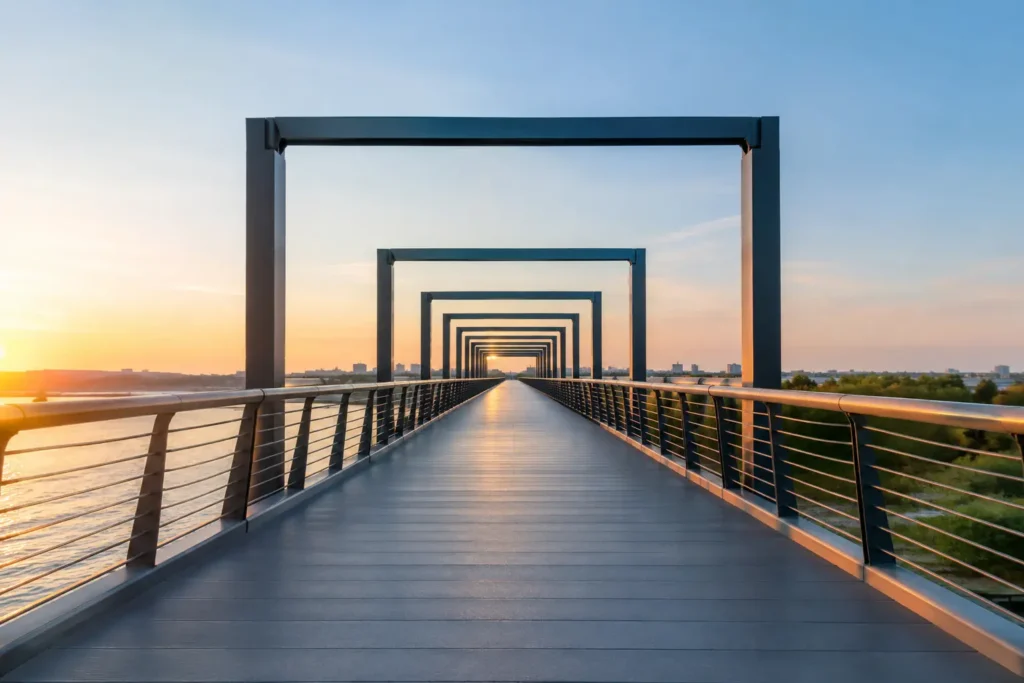
A strong leading-line composition usually has three parts: an entry point, a path, and a destination. The entry point is where the eye enters, often near a lower corner or edge. The path carries attention through the scene. The destination is your subject: a person at the end of a pier, a doorway in an alley, a mountain beyond a road, or a plate at the far end of a table.
If the path ends at nothing, the image may still work as an abstract study of shape or repetition. But it needs a clear reason. Most of the time, give the line somewhere to go.
How to find leading lines with your iPhone
Do not search only for roads and railroad tracks. Those are obvious examples, but they can make you overlook the useful lines in ordinary scenes. Scan the edges, the ground, and the spaces between objects.
In a city, look for curbs, crosswalks, building seams, handrails, tiled floors, bridges, and shadows cast by late-afternoon light. At home or in a restaurant, use table edges, cutlery, window light, shelving, or the repeated backs of chairs. At the beach, a receding tide line or a trail of footprints can do the work. For portraits, an arm, fence, or wall can guide attention toward a face.
Start by lowering the phone slightly. Many lines become stronger when they begin near the bottom edge of the frame. A high camera position often removes the foreground, which removes the visual entry point. Crouch. Hold the iPhone close to table height. Step onto the edge of a path rather than photographing it from the middle.
Then ask one direct question: where does this line end? If the answer is “at the subject,” you have a useful relationship. If it ends at a bright trash can, a parked car, or an empty corner, adjust your position or crop the distraction out before you shoot.
Move before you zoom
Leading lines respond to camera position more than zoom level. Take two steps left and parallel lines may suddenly converge toward your subject. Step back and you can include the foreground that makes the route visible. Tilt down and a floor pattern becomes a strong opening gesture.
Use the 1x camera when you want a natural perspective. Switch to 0.5x when you can place a strong foreground line close to the lens and let it stretch into distance. The ultra-wide camera exaggerates perspective, which can make a sidewalk, hallway, or architectural edge feel more immediate. It can also bend straight lines near the edge of the frame, so keep important architecture closer to the center when accuracy matters.
Do not use ultra-wide simply because the scene is large. If the foreground is weak, the wider view can add empty space without adding direction.
Put the destination where it has room to matter
The subject does not always belong in the center. A line that enters from one corner and lands on a subject near a third can create a satisfying diagonal pull. This works well for a traveler on a boardwalk, a cyclist on a street, or a landmark at the end of a bridge.
Centered placement is often stronger when lines are symmetrical. A hallway, tunnel, formal staircase, or avenue of trees can create a centered vanishing point with real force. In those scenes, fighting symmetry to follow a rule-of-thirds grid usually weakens the image. Square your phone to the architecture. Center the destination. Keep both sides balanced.
Watch the edges of the frame. A leading line that clips awkwardly into the side can feel accidental. Either let it enter confidently from a corner or give it enough space to read as a deliberate shape. Small adjustments matter here. Pan left. Tilt down. Step back.
Keep the subject separate from the line
A line should point to the subject, not cut through it. This is especially important with portraits. A railing that runs behind a person can work. A railing that appears to emerge from their head does not.
Before you shoot, check the face and shoulders. Shift your angle until the line arrives beside the subject or ends just short of it. If the subject is walking, wait for them to move into a cleaner gap. The best composition is often available for one second, not one minute.
Leading lines for common iPhone scenes
Travel and landscapes
Trails, rivers, coastlines, boardwalks, and ridge lines naturally create depth. Put the beginning of the route low in the frame, then aim it toward the horizon or a distinct feature. A lone hiker, cabin, or bend in the road gives the viewer a destination.
Keep the horizon level unless the slope is central to the scene. A crooked horizon competes with the direction of your line and can make a deliberate frame look careless. Use your iPhone’s level indicator when the horizon is visible.
Street photography
Street scenes change quickly, so build the frame before the subject arrives. Find a curb, shadow, storefront edge, or crosswalk that points into open space. Then wait. When a person enters that space, the composition resolves.
This approach is more reliable than chasing a subject and trying to organize the frame afterward. Lock focus and exposure if the light is stable. Keep enough room ahead of a moving person for the line and the gesture to breathe.
Architecture
Architecture gives you lines everywhere, which is both useful and dangerous. Too many competing directions make the frame restless. Choose one dominant route: a corridor, facade edge, staircase, or row of columns. Let secondary lines support it rather than argue with it.
Hold the phone level for clean verticals. If you deliberately tilt upward to emphasize height, do it with purpose and keep the visual destination clear. A tiny figure at the end of a colonnade or a bright doorway can turn geometry into a photograph.
Food and tabletop scenes
Leading lines are quieter here. Use the edge of a napkin, a knife, a serving board, or a row of ingredients to guide attention toward the hero dish. Shoot from a low angle when the table surface can carry the eye into the frame. Shoot from overhead when repeated shapes and place settings create a more graphic route.
Avoid arranging every object in a straight line. A slight diagonal usually feels more active. Leave the plate or drink with enough visual contrast to remain the clear destination.
Use the guide, then trust the frame
Leading lines are not a rule to force onto every photograph. A face against clean light may need no path at all. A foggy landscape may be stronger because it withholds a destination. The method works when the scene already contains direction and you need to make that direction readable.
Camera Grid can identify architectural lines and scene structure in the live viewfinder, then overlay a Leading Lines guide when the scene calls for it. Use the overlay as a framing check, not a substitute for judgment. Align the dominant route. Place the subject at its end. Watch the shutter-ring feedback, make one correction, and shoot.
The final test is simple. Open the photo and look at it for one second. Does your eye go where you intended? If it does, keep the frame. If it wanders, return to the scene and change your position before changing your settings.
Good leading lines are rarely found by standing still. Walk the edge of the scene. Lower the phone. Let the line enter with purpose. Then frame the place where it leads.