Camera Grid

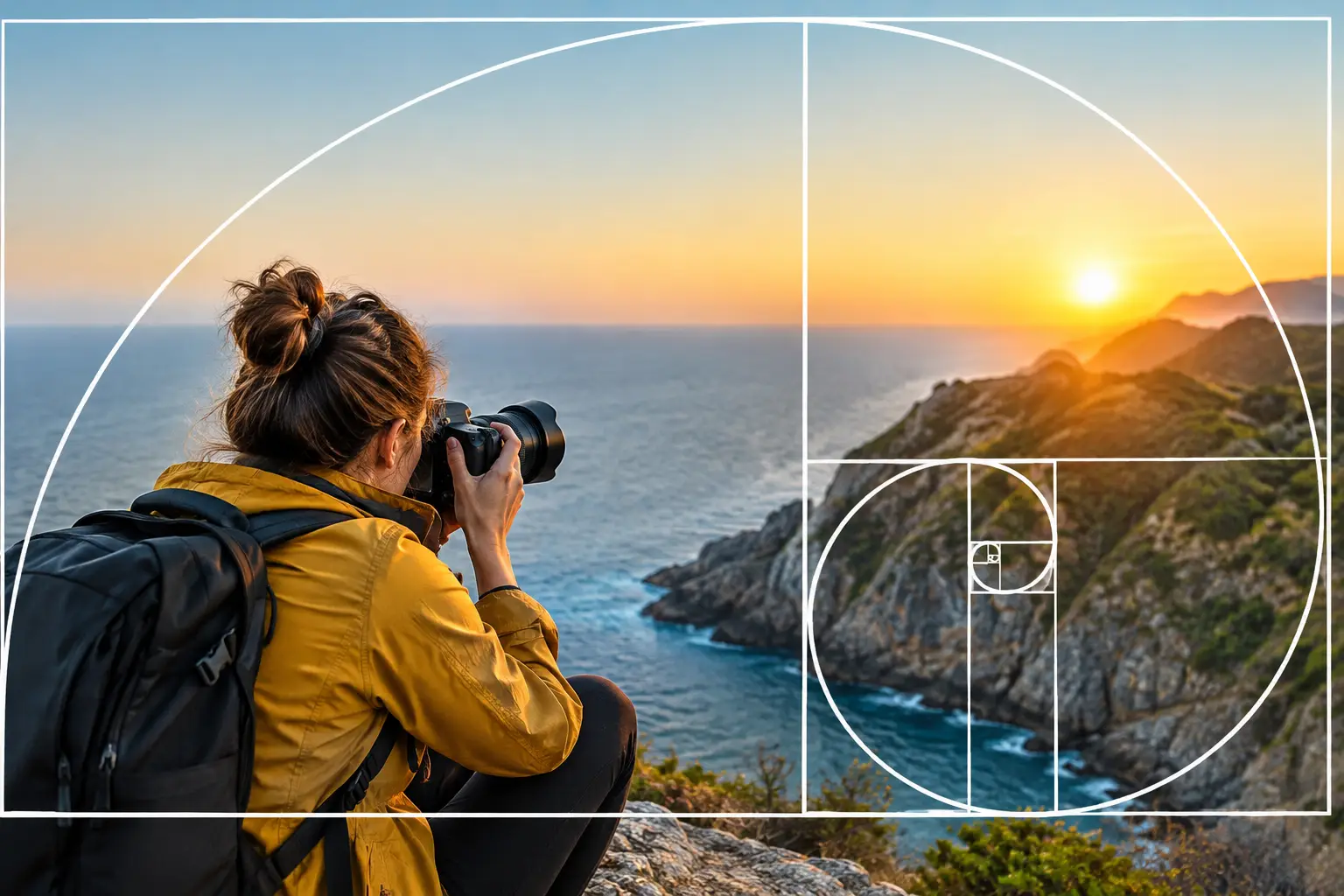
A staircase turns around a courtyard. A fork curves toward a plated dessert. A child runs along the edge of a tide pool. These scenes already contain direction. Golden spiral photography composition gives that direction a destination.
The method is not about forcing every photo into a mathematical pattern. It is about recognizing a visual path, then placing the point of greatest interest where the eye naturally comes to rest. Use it when a scene has movement, curvature, or a clear progression from large forms to small details. Skip it when the picture is built on symmetry, a strong horizon, or a direct graphic shape.
What golden spiral photography composition does
The Golden Spiral is a curved composition guide based on the golden ratio. In practical shooting, the theory matters less than the shape: a broad curve begins at the outside of the frame and tightens toward a small inner coil. Your viewer’s eye follows that curve inward.
Place the visual entry point along the wide outer section. Place the subject, face, eye, flower, garnish, doorway, or other key detail near the tightest part of the spiral. The frame gains a sense of arrival.
This differs from the rule of thirds. Thirds divides the frame into stable zones and works well for many scenes. The spiral is more directional. It suggests where the eye should travel, which makes it particularly useful when lines bend, layers recede, or one form seems to lead into another.
Do not treat the coil as a pin you must hit exactly. A subject close to it can work beautifully if the surrounding shapes support the curve. The guide is a framing tool, not a test.
Start with the scene, not the overlay
Before you look for a spiral, identify the scene’s visual flow. Ask one direct question: where would the eye enter, and where should it land?
In a landscape, the entry point might be a shoreline, road, river, or shadow. In food photography, it may be the edge of a plate, a folded napkin, or a sweep of sauce. In a portrait, it could be the line of a shoulder, hair, an arm, or a wall that curves behind the subject.
Then rotate the phone until the spiral turns in the same direction as that flow. The Golden Spiral can face any corner. Choosing the correct orientation matters more than using the guide at all. If the curve fights the scene, rotate it or choose another composition method.
Now move. Pan left or right to bring the subject toward the inner coil. Tilt up to let a foreground curve enter the frame. Step back when the scene needs more of the outer path. Step closer when the subject is getting lost inside too much background.
The adjustment is often small. One step can turn a line that ends beside the subject into a line that carries the eye directly to it.
Use the spiral when the frame has a path
Golden spiral composition works best when the photograph has an obvious route through it. Look for these situations.
Curving natural scenes
A beach cove, winding trail, curling leaf, breaking wave, or branch arch can form the outer sweep. Put the person, rock, distant boat, or patch of light near the spiral’s center. Keep the starting curve visible. If you crop it away, the image loses the visual invitation that makes the composition work.
At sunset, resist placing every dramatic element in the coil. Let the sky provide space. A small sun or lone figure at the inward endpoint often feels stronger than a frame crowded with equal claims on attention.
Environmental portraits
A portrait gains depth when the surroundings guide attention toward the person rather than compete with them. Use a curved stair rail, café booth, garden path, or doorway edge as the outer motion. Position the subject’s nearest eye near the inner coil.
This is especially useful when the subject is not facing the camera squarely. A turned shoulder and looking glance can create a natural curve through the body. Keep the background simple enough that the face remains the endpoint. If a bright sign or window sits beyond the face, change position or lower exposure. Your eye will follow brightness just as readily as a line.
Food and tabletop scenes
Overhead food photographs often benefit from the spiral because plates, utensils, linens, and ingredients can be arranged with deliberate motion. Start with a larger shape at the edge: a napkin fold, spoon handle, or slice of bread. Curve smaller elements toward the hero detail, such as the cut surface of a pastry or the garnish on a drink.
Avoid arranging every item along the curve. The result can look staged. Build one strong route and leave some quiet negative space. The subject should feel discovered, not diagrammed.
Architecture and travel
Spiral staircases are the obvious example, but subtler architecture can work better. A rounded arcade, curved facade, fountain edge, or road wrapping around a building gives you a path without making the geometry feel predictable.
Set the visual destination on a person, open door, patterned window, or distant landmark. Watch vertical lines near the edges. If the phone is tilted too far, a strong spiral can be undermined by buildings that appear to fall outward. Level the frame first, then refine the curve.
Know when not to use it
A Golden Spiral is not a universal upgrade. Some scenes need a cleaner structure.
Use centered composition for a face-on portrait, reflection, tunnel, or facade with true symmetry. Use a horizon-based guide when the sky and land are the main story. Use leading lines when a straight road, rail, or row of lights creates a stronger directional pull than any curve. Use the rule of thirds when the scene has two separate subjects that need balanced placement.
The most common mistake is trying to find a spiral in a scene that has none. A wide field with one tree may need simplicity, not a curve. A fast-moving child may need speed and clean framing, not a careful geometric fit. Take the photo while the moment is alive.
There is another trade-off: the spiral can make a frame feel more intimate and enclosed. That is useful for mood, detail, and visual momentum. It is less useful when you want the openness of a broad landscape or the formal clarity of architecture. Decide what the scene needs before reaching for the guide.
A fast iPhone workflow
The best time to apply composition is before you press the shutter. Do not plan to fix it later with a crop. Cropping can improve placement, but it often removes the very curve or negative space that gave the image its flow.
Start at your intended focal length. The 1x camera is often a strong choice because it preserves the context needed for the wide outer curve. Use 2x or 3x when the scene already contains a clear curved path and the subject needs more presence. Ultra Wide can exaggerate foreground curves, but keep important faces away from the edges where distortion can distract.
Hold the phone steady and set focus on the destination point. For portraits, that is usually the nearest eye. For food, it may be the sharp edge of the main ingredient. Then lock exposure and focus if the camera keeps shifting as you reframe.
Camera Grid can place the Golden Spiral over the live viewfinder when the scene calls for it, so you can test orientation and make the correction before capture. Follow the curve, then trust the image rather than the overlay. If the strongest version requires the subject slightly off the coil, take it.
Field check before you shoot
Run a quick visual check. Is there a clear outer entry point? Does the eye travel inward without getting interrupted? Is the final destination the brightest, sharpest, or most meaningful detail? If the answer is yes, the frame is likely doing its job.
Also check the edges. A partial hand, cut-off utensil, bright sliver of sky, or stray sign can pull attention out of the spiral. Clean edges keep the viewer inside the photograph. Reframe, wait a second, or move one object if you can.
Then make two versions. In the first, place the subject close to the inner coil. In the second, give the curve more room and let the subject sit slightly farther away. On an iPhone screen, the tighter frame may look immediately stronger. Later, the wider version may have more atmosphere. The right choice depends on whether the photograph is about the subject or the journey toward it.
Golden Spiral composition becomes useful when you stop seeing it as a formula. Look for a path. Give the eye somewhere worth arriving. Frame it. Lock it.